install.res
install.res
install.res is an EU project that aims at stimulating large-scale demand for heat pumps in existing buildings. In five different countries, alternative and innovative business and delivery models are tested, demonstrated and scaled-up to support a simple and affordable heat pump roll-out.
© Austrian Energy Agency
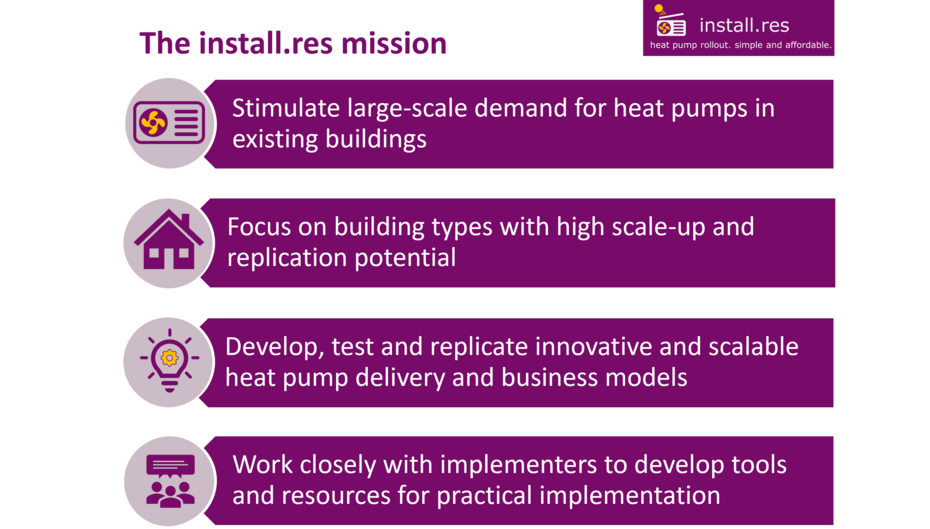
install.res focuses on the existing building stock since it holds the highest greenhouse gas reduction potential as most buildings still rely on fossil fuels for heating. However, it is not yet broadly known that developments in heat pump technology already allow for a very efficient and broad application of heat pumps in existing buildings. Modern heat pump can supply flow temperatures of 55°C with a very high efficiency which makes it possible to install modern heat pumps in existing buildings – often even without changing the radiators or retrofitting the building envelope.
The project deals with innovative, cost- and time-efficient delivery and business models for the installation of heat pumps in existing buildings. It thereby goes beyond the scope of just showing ways how to implement heat pumps but showcases how heat pumps can be installed faster and in a more simple and affordable manner.
In Austria, North Macedonia, Poland, Slovenia, and The Netherlands, install.res sets up demonstration project to develop, test and evaluate alternative and innovative delivery and business models for heat pumps. Such models aim at reducing barriers like high up-front investments, lack of financing possibilities or reliability risks for end consumers.
Building on the experience from the demonstration sites and knowledge from experts in the field, a set of dedicated and tailor-made resources (e.g. manuals, tools, guidelines and trainings) – the so-called fast-track schemes – are developed. These materials are intended to provide assistance in the areas of technical implementation, financing, communication and best practices. They will be integrated into established national and European platforms and training curricula for heat pump solutions.
The fast-track schemes are designed to enable implementers, end consumers and other relevant stakeholders in the building sector to roll out heat pumps at a higher speed than today and increasing affordability. This way innovative delivery and business models for heat pumps will become ready to be replicated across the EU.
Publications
Catalogue of Delivery Models: This catalogue helps end customers gain a basic understanding of the technical components of a heat pump supply system. It also assists them in deciding on the most suitable combination of components for their building, including heat source and sink, central distribution, heat release and domestic hot water.
Catalogue of Business Models: The catalogue provides an overview of alternative business models for heat pumps. Twelve business models are described in brief, with their strengths and weaknesses outlined. The second part of this catalogue deals with the country-specific framework conditions and the potential of various business models in the install.res partner countries (Austria, the Netherlands, North Macedonia, Poland and Slovenia).
Project data
| Client / Funding organisation | LIFE Project co-funded by the European Union |
| Project management | Herbert Tretter |
| Project team |
Louise Meister Barbara Alexander-Bittner Christian Furtwängler |
| Project partners |
Institute for Building Research & Innovation, Austria Sozialbau AG, Austria Housing Europe, EU level The Heat Transition Makers (DWTM), The Netherlands SDEWES-Skopje, North Macedonia KAPE, Poland Jozef Stefan Institute, Slovenia Kronoterm, Slovenia |
| Project duration | November 2024 to October 2027 |
Contact person
![[Translate to German:] Mitarbeiterfoto von Herbert Tretter, Senior Expert Renewables](/fileadmin/_processed_/6/2/csm_herbert_tretter_0b3b9a4b5f.png)


Senior Expert | Renewables
Ing.in
Barbara Alexander-Bittner,BA
Email addressBarbara.Alexander-Bittner@energyagency.at