Emission-free Mobility
Promoting emission-free, efficient and active mobility
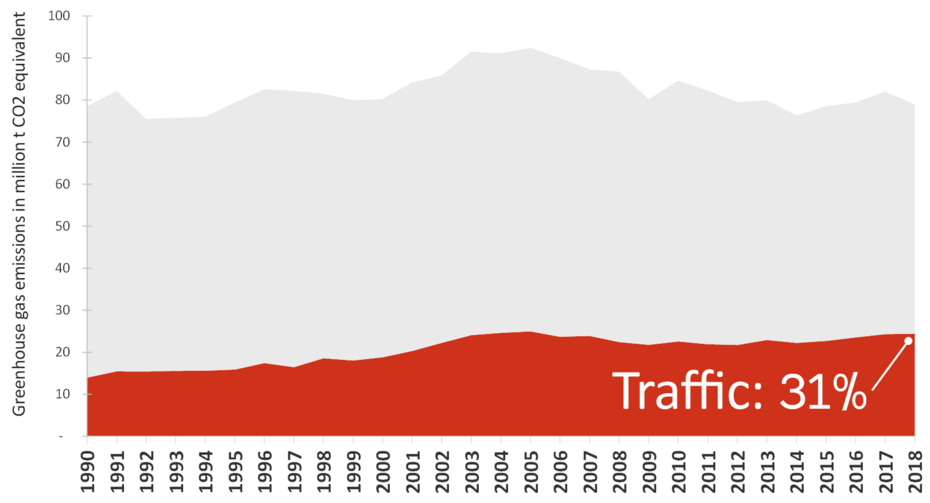
In 2018, the transport sector was responsible for almost 36 per cent of Austria's final energy consumption and, at 31 per cent, was a major source of national greenhouse gas emissions. The share of renewable energy in this sector, however, is only 10 per cent. On the path towards climate neutrality by 2040 – the declared goal of the Austrian Federal Government – reducing emissions in mobility is one of the greatest challenges. Addressing this requires a comprehensive package of diverse measures.
Austria's greenhouse gas emissions from 1990 to 2018. Greenhouse gas emissions from transport have increased by 75% since 1990, with road transport accounting for the majority (97 per cent); its share of total emissions was 31% in 2018. (Data: Environment Agency Austria, 2020)
Avoid – Shift – Improve
The package of measures for climate-friendly transport systems follows the principle of "Avoid – Shift – Improve". Shorter travel distances – for example through the revitalisation of town centres – as well as technical solutions such as web conferences instead of business travel help to avoid traffic. In addition to intelligent mobility management and many other measures (ride sharing, carpooling and so on), spatial planning plays a key role.
Our need for mobility will remain. It is therefore essential to promote emission-free modes of transport to shift traffic towards them. This includes expanding public transport services such as rail and bus, as well as ensuring pan-European connectivity. Particularly important – as the COVID-19 crisis has clearly shown – will also be the expansion of infrastructure for cycling and walking. In freight transport, shifting transport volumes from road to rail is crucial.
Transport that can neither be avoided nor shifted must be improved. This primarily means transitioning to electric mobility in private motorised transport (cars and two-wheelers) and developing emission-free drives in heavy-duty transport (lorries, shipping and aviation). In the case of the latter, the use of green hydrogen is an important option alongside battery-electric mobility.
We provide answers for emission-free mobility
Due to its strong interlinkages with the energy system, mobility is an integral part of our work and plays a major role in projects relating to scenario development as well as climate and energy policy. Our objectives are clear: out of fossil fuels and import dependency, into renewable energy sources and greater domestic value creation.
In addition, our experts in transport systems, spatial planning and engineering provide answers to specific questions concerning the mobility of the future. We focus in particular on accelerating the market penetration of electric mobility and on expanding services and infrastructure for active mobility – with a special emphasis on cycling.
Contact
![[Translate to German:] Mitarbeiterfoto von Christoph Link, Senior Expert Mobility & Spatial Planning](/fileadmin/_processed_/8/3/csm_christoph_link_1_438f985fc4.png)